Rachel Whiteread (b. 1963, UK) is a leading contemporary sculptor renowned for her casts of negative spaces. Using materials such as plaster, resin, and concrete, she transforms the invisible interiors of domestic objects and architecture into tangible forms, exploring absence, memory, and the traces of human presence.
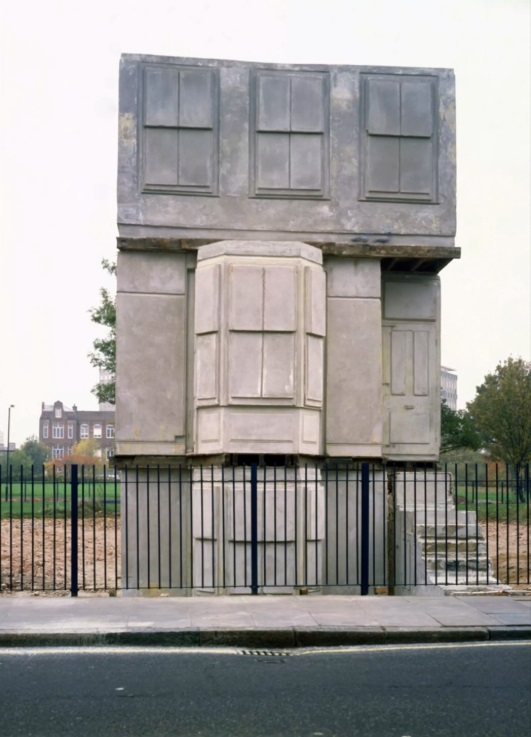
House (1993) was a life-sized cast of an entire East London house, solidified in concrete. By turning the interior void into a monumental solid, Whiteread transformed domestic memory into a public monument, making absence itself the subject of contemplation.
Rachel Whiteread’s House is one of the most powerful meditations on the memory of space. Her material framework relies on casting and inversion—using hard concrete to preserve the soft, transient traces of habitation. Through this methodology of “presence through absence,” the work materializes memory itself, resonating with Maurice Merleau-Ponty’s phenomenology of space, where space is not merely occupied but felt.
Whiteread constructs psychological landscapes through sculpture, aligning with Rosalind Krauss’s concept of sculpture in the expanded field—where form intersects with architecture, concept, and memory. By reversing space into solid matter, she compels viewers to confront time and loss both physically and emotionally.
For my own practice, Whiteread inspires me to see that space can be sculpted—that memory and emotion can inhabit voids as meaningfully as solid form. Her approach encourages me to treat material not just as structure but as a vessel of remembrance. In my miniature sculptures, I seek to explore this interplay between inside and outside, presence and absence—crafting spaces that hold both physical stillness and emotional resonance, like silent echoes of lived experience.
#Negative Space Sculpture #Materiality of Memory #Phenomenology of Space #Absence and Presence
Image credit and wbsite:
Written on: 10 August 2025
 Ning-Hui Chung
Leave a comment