Jenny Saville (born 1970, UK) is known for her monumental depictions of the female body. Through dense brushwork and distorted forms, she challenges social ideals of beauty and representation, revealing the body as a site of vulnerability, desire, and defiance.
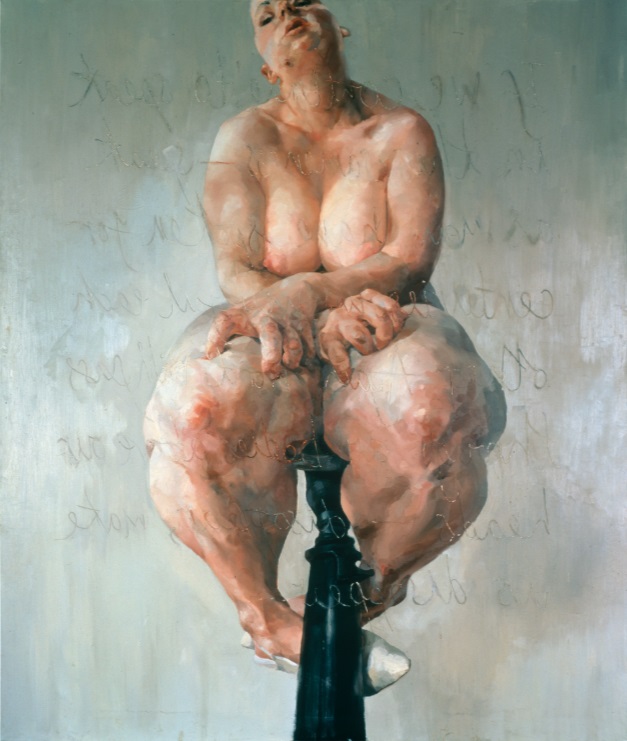
Propped (1992) portrays a nude woman seated before a mirror from a confrontational angle. Saville’s dense brushwork and fleshy tones heighten the tension of being seen. Inscribed with Luce Irigaray’s feminist text, the painting resists objectification, reclaiming the act of looking as empowerment.
Saville’s work treats the body as text, layering oil paint to reconstruct sensory experience. Her material framework is rooted in the physicality of flesh—thick, fluid, tactile—turning the canvas into a skin-like surface. This aligns with Luce Irigaray’s feminist theory of embodiment, which frames the female body as fluid and multifaceted, resisting definition. Saville’s methodology merges expressionist force with anatomical precision, transforming the body into a site of psychic tension, echoing Julia Kristeva’s notion of abjection: confronting imperfection to expose suppressed emotion and desire.
Rather than idealizing beauty, Saville destabilizes it—forcing viewers to question power and perception. For my sculptural practice, she teaches me that materiality can carry psychological weight. Texture, density, and imperfection can articulate emotion as powerfully as form. In my miniature sculptures, I seek to translate her visceral “flesh language” into spatial experience—crafting works that are not only seen but felt, turning fragility and distortion into gestures of truth and empathy.
#feminist art #body and identity #representation of flesh #vulnerability and strength #body politics
Image credit & website:
https://gagosian.com/artists/jenny-saville/
Written on: 7 September 2025
 Ning-Hui Chung
Leave a comment