Doris Salcedo is a Colombian contemporary artist known for her deeply poetic explorations of violence, disappearance, trauma, and memory. Her work reconfigures everyday materials—such as furniture, clothing, and shoes—into quiet yet powerful memorials. Rather than narrating trauma directly, Salcedo transforms material and spatial forms into vessels of remembrance, allowing absence itself to speak with haunting presence.

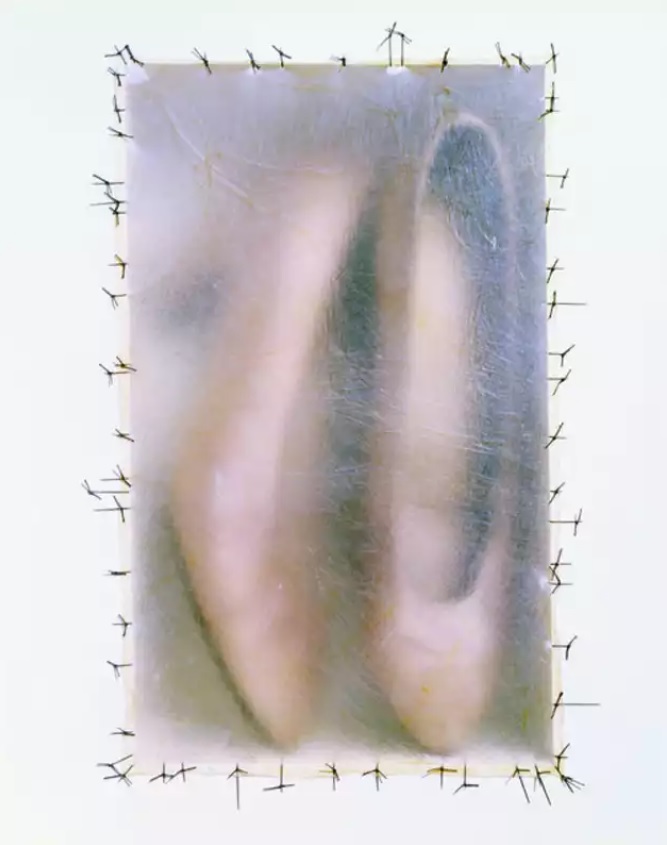
Atrabiliarios is an installation embedded directly into the wall. Salcedo encases the shoes of missing women behind translucent animal-bladder membranes, stitched into rectangular recesses. The hazy visibility of these objects evokes both concealment and remembrance—an intimate memorial to lives erased by violence. Through restrained material gestures, Salcedo transforms trauma and mourning into a tangible, architectural form of collective memory.
When I first encountered Atrabiliarios, I was struck by Salcedo’s intelligent material choices. The shoe acts as a powerful symbol of absence—an interrupted journey—while the stitched animal-bladder membrane creates a semi-transparent barrier that speaks of concealment and forgotten bodies. Her material language resonates with Susan Stewart’s idea of the miniature as a container of memory (On Longing) and Gaston Bachelard’s notion of the house as a poetic interior space (The Poetics of Space). Salcedo transforms the wall into an architecture of remembrance, where trauma quietly inhabits material.
For my own practice, her work inspires me to see materials as emotional and historical agents. Sculpture, in this sense, becomes not only a physical construction but also a condensation of time and affect. Her sensitivity to scale, repetition, and tactility encourages me to explore how delicate textures and spatial intimacy can evoke memory within my small-scale works. Through Salcedo, I’ve learned that material is narrative—that every surface, fiber, and void can embody loss, resilience, and the silent endurance of the human spirit.
#Materiality #TraumaAndMemory #FeministArt #Symbolism #PoeticSpace #PsychologicalSpace #ViolenceAndSilence
Image credit & website:
https://www.icaboston.org/art/doris-salcedo/atrabiliarios/
https://www.artsy.net/artwork/doris-salcedo-atrabiliarios
Written on: 19 October 2025
 Ning-Hui Chung
Leave a comment